The Golden Idol of Bob Mackie Barbie: A Reclaimation
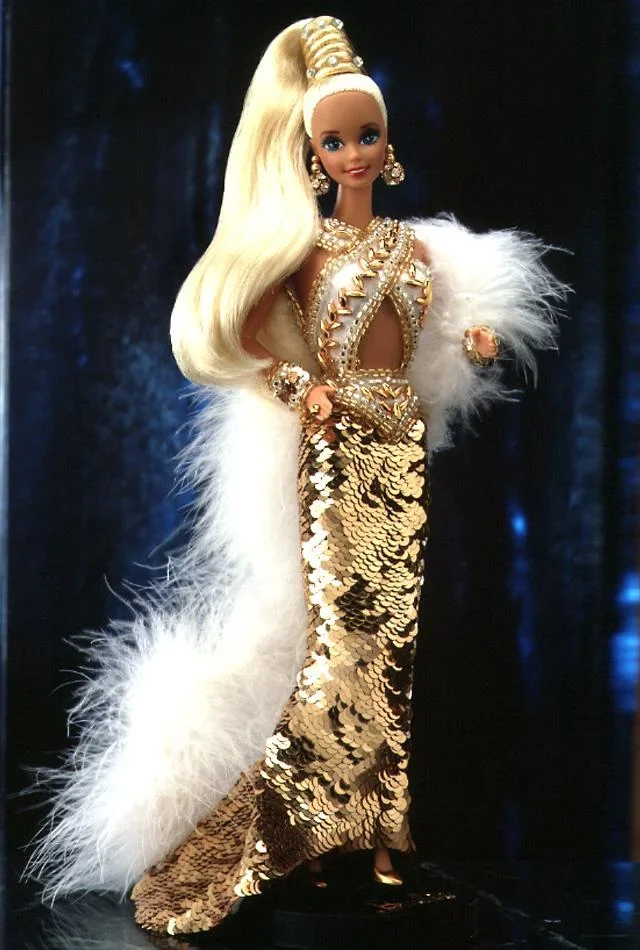
There are objects you recognize before you fully understand why they matter to you. The Bob Mackie Gold Barbie was one of those objects for me.
Long before I had language for queerness, aesthetics, camp, or even the complicated feeling of wanting something you suspect you are not supposed to want, I recognized her instantly. I remember standing in toy aisles pretending not to stare too long. The gold. The impossible glamour. The drama of her. She shimmered in a way that felt almost unreal, like she had arrived from another world entirely. Not a quiet or respectable world, but one built from spectacle, fantasy, and unapologetic beauty. Even as a child, I knew there was something liberating in that.
The world around me, meanwhile, felt painfully narrow. Boyhood in the late twentieth century came with rules that were rarely spoken directly but enforced constantly anyway. Boys were supposed to like action, competition, toughness, practicality. We were handed toys that moved, exploded, transformed, fought. Girls, meanwhile, were allowed beauty, softness, imagination, intimacy, display. Looking back now, I can see how rigid those divisions were, but as a child they simply felt like atmosphere. You breathed them in without realizing it. And when you were queer, or feminine, or drawn toward beauty in ways that did not line up with masculinity, you learned very quickly how visible your desires could become to other people.
What I remember most clearly is not being explicitly forbidden from wanting Barbie so much as being quietly redirected away from her. A joke here. A look there. A suggestion that this was “for girls.” Sometimes that kind of soft correction cuts deeper than outright punishment because it teaches you to police yourself. You start rehearsing masculinity before you even understand what masculinity is. I became aware, very young, that desire itself could make you vulnerable. Not sexual desire exactly, not yet, but aesthetic desire. Emotional desire. The desire to be close to beauty. The desire to inhabit glamour rather than stand outside of it pretending not to care.
And Bob Mackie Barbie was glamour in its purest form. She was excessive in the most queer way possible. Everything about her felt heightened: the metallic gold, the theatrical silhouette, the sheer refusal of subtlety. She belonged to the same visual universe as Cher, Las Vegas revues, sequins under stage lights, women descending staircases to applause. There was something profoundly queer about that world even before I understood why. It was artifice used not to hide truth but to reveal it. That is something queer people often understand instinctively. Sometimes performance is the most honest thing there is.
I think that is why the doll stayed with me for so many years, even when I did not own her. She became less an object and more a kind of emotional landmark. A reminder that another version of life existed somewhere beyond the smallness of masculine expectation. I did not have the language then to say that I was seeing camp, or queer aesthetics, or the refusal of compulsory masculinity. I only knew that the doll made me feel more alive than the things I was supposedly meant to want.
Years later, returning to dolls as an adult has felt much less like nostalgia and much more like reclamation. Nostalgia suggests sentimentality, a longing for childhood innocence. That is not really what this is. It is closer to recovering pieces of yourself that got buried under performance and survival. Buying the dolls I once stared at from a distance feels strangely emotional sometimes because it collapses time. The adult collector and the queer child in the toy aisle meet each other for a moment. There is grief in that encounter, but also tenderness.
As an anthropologist, I can talk about dolls as material culture, as objects that carry social meaning, as artifacts that participate in gender formation and identity construction. All of that is true. But the more honest truth is simpler and more personal than theory. Sometimes an object holds the shape of a self you were not yet allowed to become. Sometimes a doll becomes a kind of witness. When I look at the Bob Mackie Gold Barbie now, I do not just see a collectible. I see a young queer kid reaching toward beauty before he had words for why beauty mattered so much to him. I see someone trying to survive the loneliness of feeling different by attaching himself to glamour, fantasy, and theatricality. I see the early beginnings of a life built around aesthetics, performance, embodiment, and the belief that exaggeration itself can be a form of truth.
And maybe that is why queer people have always understood dolls differently. Not because we mistake them for people, but because we recognize in them the performance of becoming. The ability to invent yourself. To adorn yourself. To refuse the limits other people place on your body and imagination. The Bob Mackie Gold Barbie did not simply represent femininity to me. She represented permission.
